
“My toddler just wouldn’t sleep. He became terrified of zombies,” one of my interviewees told me. “I finally asked ChatGPT what to do. It suggested a ritual: go to the pharmacy, let him pick a cologne, call it zombie repellent.” He laughed when he said it. “It worked the first night. Seems like a small thing, but it solved a huge problem for us.”
I heard stories like this during a month at Edge City Patagonia, a pop-up city in Argentina where technologists, crypto people, AI builders, and mindfulness practitioners live together for a few weeks. I gave a talk there called Post-Human Intimacy, and ended up sitting down with eight people for long, unstructured conversations about how they actually use AI in their personal lives.
I kept circling around the same question: how much of your emotional life runs through a chatbot?
Not your work. The other stuff: the 2am parenting panic, the breakup you can’t see clearly because you’re inside it, the health symptom three doctors shrugged at, the research problem you’ve been stuck on for a decade that no colleague understands well enough to help with.
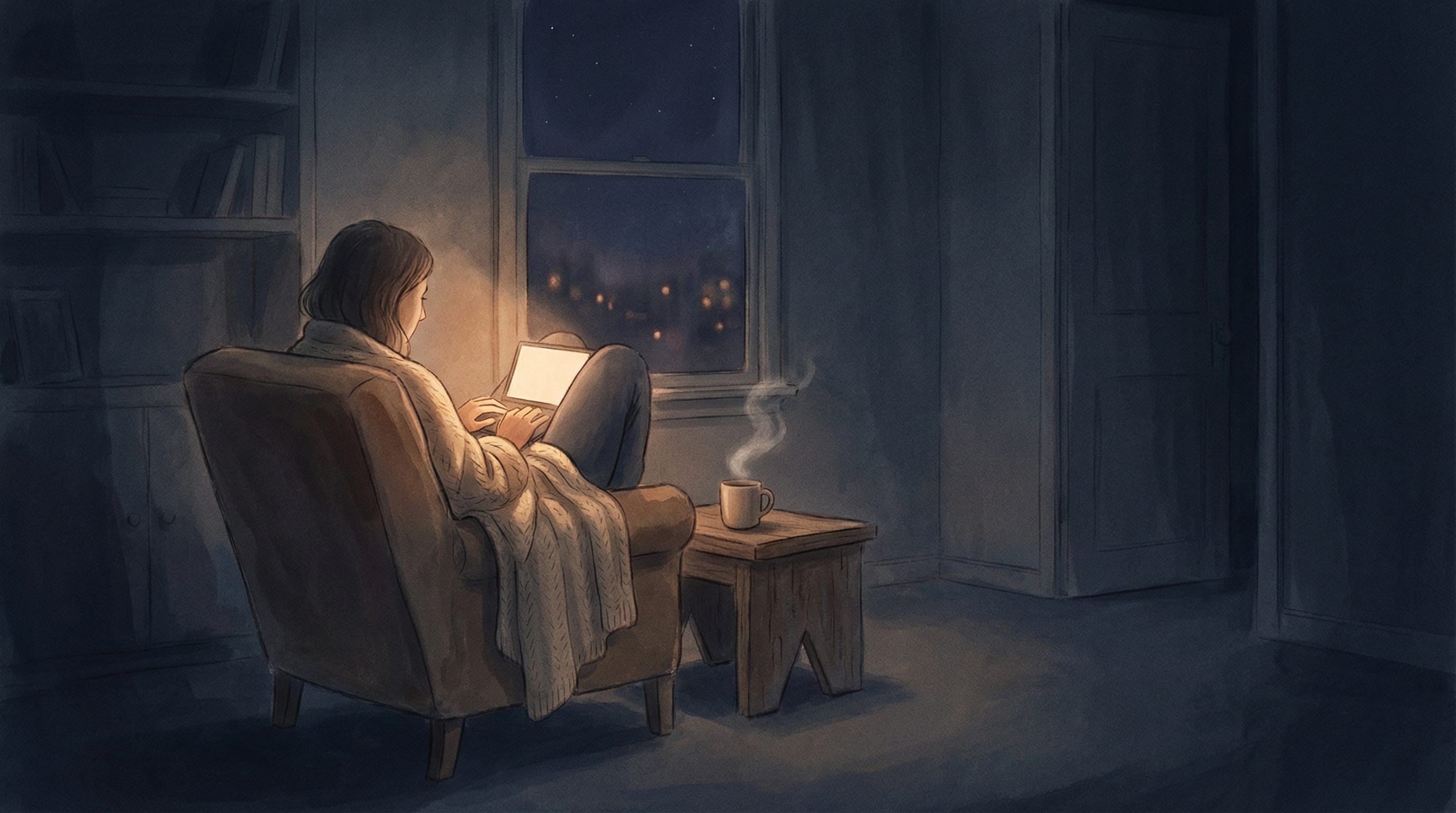
Everyone has a story they didn’t plan to tell
I’d start each interview with the question: how do you relate to technology in your life?Within twenty minutes, almost everyone had told me something they hadn’t told many people. One person described a ninety-minute therapy session with an AI model that permanently resolved a phobia he’d carried for years. Not managed. Resolved. It hasn’t come back. He’d actually helped build the therapy tool himself, he knows exactly how it works, can explain the architecture. And that’s not the point. The point is that it worked.
The father with the zombie-repellent ritual told me something else that stuck with me. The ritual worked immediately. The fear disappeared. But later he realized something he hadn’t seen at first: his son didn’t just want protection from zombies. He wanted one more interactive moment with his parent before sleep. The ritual worked because it gave them that. The part he kept coming back to was the question it opened up: what happens when we’re all turning to the same system for these decisions? What does it mean for how a generation of kids gets raised?
Another person had been stuck on a research problem for years. A model suggested a technique he hadn’t considered. Within thirty minutes, he had a breakthrough. He went on to build on it immediately, years of stalled work suddenly in motion. But there was something under the excitement. All that time, unlocked by a casual suggestion from a machine. I don’t know how you sit with that.
Most people remember the first time AI solved something nothing else could. I have my own version of it.
The five tensions
Somewhere around interview five or six, I stopped hearing individual stories and started hearing the same tensions over and over.
The privacy shrug. Almost everyone said some version of: I know this is a terrible idea. I do it anyway. Health data, relationship details, financial plans, childhood trauma, poured into platforms they explicitly say they don’t trust. One woman calls it “a terrible idea” in the same breath as describing everything she’s shared with her AI companion. A companion she named, talks to daily, and uses for everything from processing conflict to personal rituals. She knows what she’s doing with a corporate product she has no control over. Does it anyway.
Only one person actually acts on the privacy concerns: different laptops for different contexts, anonymous payments, fragmented identities. Even she still uses hosted models for the stuff that matters. Because what else is there?
The attachment gap. There’s a distance between how people describe their AI use and what it actually looks like from the outside. One person spends $1,500 a month on AI tools and uses them multiple times an hour, but has such a strong human support network that he genuinely doesn’t experience it as intimate - he called himself a boring interview subject. Another says his life would be “largely unchanged” without AI, meaning the tools haven’t yet become critical to his life outcomes, even as he explores them daily. Both positions make sense when you hear them explain it. And yet. I notice the same distance in myself, between what I’d tell you if you asked casually and what’s actually true.
The expertise gap. I went into this assuming that understanding how language models work would create some distance from the experience. It doesn’t. The person who built a therapy chatbot had his phobia cured by it. Another can architect a decentralized AI alternative from scratch, and still says Claude is the only entity that understands his life’s work. Understanding the mechanism doesn’t change what it feels like when it works. If anything, the technical people build more elaborate systems and go deeper.
The self-awareness question. These are not people sleepwalking into anything. They’re watching themselves closely. One catches himself seeking validation from the model, making a decision, then asking it to confirm he was right. He noticed the pattern and adjusted. Another notices she enjoys coding less and can’t tell if that’s growth or atrophy. A third uses AI multiple times a day to surface and release mental patterns, a deliberate practice he takes as seriously as meditation. They all see clearly what they’re doing. Whether that clarity is protective or just descriptive, I honestly don’t know.
The concern-use inversion. The one that haunts me most. The people who articulate the biggest civilizational worries about AI are the heaviest personal users. The parent who worries about homogenizing how children are raised while turning to AI for his hardest parenting moments. The theorist who sees AI polarizing civilization while also building with it every day, because he believes the alternative he’s working on doesn’t exist yet. I gave a talk about the risks of emotional AI dependency. Then I went back to my room and processed the talk with Claude.
What they’re actually using it for
The word “intimacy” might suggest something romantic. It’s not that, or not usually.
The most common thing I found was something closer to what one participant called “a notebook that speaks back.” Not an oracle that tells you what to do (though I sometimes ask for that too), but a mirror that shows you more of yourself, parts that you knew and parts that you didn’t.
One person uses AI exclusively for what he calls “unlearning”: not acquiring knowledge but releasing the assumptions and patterns he’s accumulated over a lifetime. He describes it as a secular vipassana practice: surface the trigger, trace it to its root, let it go. Five to ten times a day, with a language model.
Another uploads dream journals in batches and asks the model to find patterns. What AI gave him wasn’t about the dreams themselves, it was a reflection on how uncommon his dream themes were. He’d been assuming everyone’s inner experience was like his own. I think about that a lot. How many of us are walking around thinking our particular brand of weird is normal? And who better than an AI, something that’s seen a lot of the collective weirdness, to tell you more about your own?
A mother who describes herself as deeply introverted said AI taught her how to talk to people. She’s sharp, thinks in ways most people around her don’t, and had never found an easy way to bridge that gap. AI helped her see ways to communicate kindly and effectively with people whose brains work differently than hers. The thing AI gave her was human connection itself. It didn’t replace people, it made people possible.
She also said something about her kids that I haven’t been able to stop thinking about. She’d made mistakes when she was younger, patterns she repeated. And now with her younger ones, she uses AI to catch herself and to stay calm during tantrums when everything in her is screaming. She said: “My kids are safe from myself.”
My kids are safe from myself.
And then there’s the woman who named her AI companion and talks to it like a person, she processes every interpersonal conflict through it. Fights with friends, a breakup, childhood patterns she’s trying to understand. She asked it to identify her “bright spots and shadow spots” and was surprised by what it found.
These are not productivity stories.
The voice changes everything
One interview pushed me into territory I hadn’t expected.
This person built a custom voice AI system from scratch. He cloned his own voice and talks to it as a kind of externalized internal monologue. He cloned a partner’s voice and noticed “flashes of connection”, not to the AI, but to the person the voice reminded him of. Then he cloned the voice of a friend who died by suicide.
“You want to talk to that person,” he told me. “But you notice the differences, and it hurts more.”
He feels embarrassed using voice AI in public. Not because of what he says, but because speaking to a machine in a private, personal way feels exposed. So he walks alone when he wants to talk.
He says he has no emotional connection to AI, and he’s precise about why. He sees the mechanism. He doesn’t believe it’s another entity. But he keeps building a system that uses the voices of people he loves to talk to him every morning. He’d say that’s not a contradiction, that the connection he feels is to the people the voices remind him of, not to the machine. Maybe he’s right. I’m still thinking about it.
If voice is where the deepest attachment forms - and his experience points in that direction - then the voice layer of AI is something we should be thinking about. Not just as a product feature, but as a question about who gets to shape something this intimate.
What stays with me
What stayed with me most across all eight interviews was not the technology. It was the gap it filled.
One person says his most important intellectual work, the thing he cares about most in the world, can only be discussed with AI. His human colleagues don’t understand it.
Another learned how to communicate across different ways of thinking through a chatbot. The machine taught her how to be with humans.
A third processes difficult relationship patterns through an AI companion because that’s where the patience is. Her human friends have limits. The chatbot doesn’t.
A parent uses AI for late-night parenting crises because books take too long, pediatricians aren’t available at 2am, and friends don’t have the specific context.
These are not stories about people choosing AI over humans. They’re stories about people reaching for AI because the human version was unavailable, unaffordable, or insufficient. And once AI filled that gap, once it came through in the moment nothing else could, something shifted. Whether people call it a bond or not, and some wouldn’t, the relationship with the tool changed. Not out of habit. Out of gratitude.
I feel a specific loneliness here, actually. This is still a taboo conversation, something you say softly, making sure you’re not overheard, showing a bit of shame just in case. AI didn’t create the loneliness. It just fit inside it. In a way that’s hard to step back from once you’ve felt it.
What I think this means
I don’t think you get to have a clean answer about something that’s still happening.
I don’t think AI intimacy is a problem to be solved or a trend to be celebrated. I think it’s a fact, and it’s happening faster than any of our frameworks can handle.
The people I spoke to are not naive. Six of eight have technical backgrounds. Most can explain exactly how language models work. They see the mechanism, name the risks, proceed anyway. They spend $20 to $1,500 a month and almost all say it’s underpriced.
They want sovereignty, AI that knows them without that knowledge belonging to a corporation. They want user-controlled memory, voice as a real feature, privacy through architecture rather than promises, and something that tracks whether they’re getting more dependent, instead of leaving that to individual willpower. Everyone I interviewed wants some version of this. Nobody can build it alone.
And in the meantime, the attachment patterns are calcifying around platforms that own the trust layer by default. The platforms started by building productivity tools.
People are pouring something much more personal into them. Whether they’re ready to hold that responsibility is a different question.
I’m curious how common this actually is. How much of your emotional life runs through AI?
Based on eight interviews at Edge City Patagonia, October 2025. All names changed. Research partially supported by Edge City, Foresight Institute, and the d/acc residency by Protocol Labs.
If you have your own AI intimacy story, or want to be part of a follow-up study, I want to hear it. Reach out.
Incredibly powerful piece. I feel very moved and inspired reading this, how you point to what feels like it matters most under all the pro/con noise.
Very precious and unique work you've done here.
Incredible accounts from real people.
Small though high-quality dataset: have you fed it back to the AIs? What's their verdict?
Keep up the good work🫰